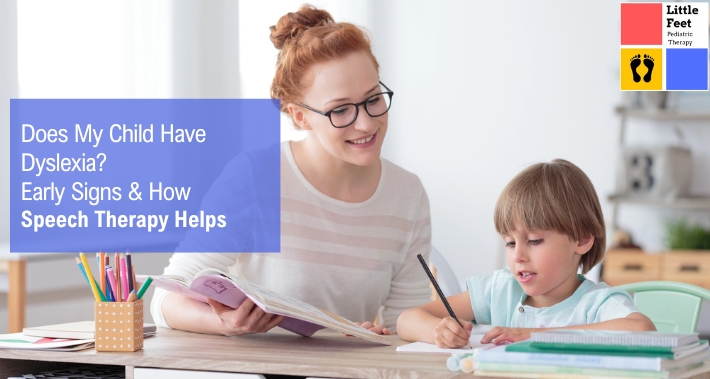
Are you concerned that your child might have dyslexia?
Dyslexia is an uncommon, though not rare, type of learning disability.
Prevalence rates vary, but experts estimate that around 10% of Americans are dyslexic.
Dyslexia can interfere with your child’s development, including their reading, writing, and behavioral skills.
So, if this sounds like your child, you might consider booking them in with a licensed speech therapist for a full evaluation.
Speech therapy is a valuable tool that helps kids navigate their dyslexia journeys.
At Little Feet Therapy, we can put together a personalized intervention plan that reflects your child’s unique strengths and challenges.
We can help your child discover the right types of accommodations for their reading and writing challenges.
This will help them build confidence and ensure they catch up with their peers.
Have we piqued your interest?
In this article, we’ll highlight some of the common warning signs of dyslexia in your child and how pediatric speech therapy can help.
Read below to find out more.
What Is Dyslexia?
Let’s start with the basics: what is dyslexia?
Dyslexia is a type of learning disability.
It impacts the way your brain processes written language.
In people without dyslexia, written language cognitive processing goes a little something like this:
First, your eyes detect a piece of writing.
Next, your brain interprets that writing and assigns meaning to each individual word.
This process helps us understand the meaning of words we read and how those words work together to create a sentence.
People with dyslexia, on the other hand, experience disruption in this process.
For instance, they might see the word “tab” instead of “bat”.
Subsequently, children with dyslexia often experience speech, language, and literacy challenges.
Without intervention, children with dyslexia are at a higher risk of illiteracy, self esteem, and mental health challenges later in life.
Fortunately, a pediatric speech therapist can help you and your child navigate their literacy challenges and help create strategies to avoid lifelong difficulties.
What Are The Signs My Child Is Dyslexic?
Dyslexia can affect your child’s life in several ways.
You may notice signs around the time your child learns to read.
However, this condition affects more than just their reading skills.
Children with dyslexia often have trouble matching letters with their associated sound.
They also face challenges with their writing and spelling skills.
Additionally, your child might find it harder to communicate more complicated thoughts and sentences.
Some children experience more mild symptoms, whereas others live with moderate or even severe challenges.
Your child’s age can also impact their symptoms.
Let’s take a closer look.
Signs Of Dyslexia In Preschool Age Kids
Many dyslexic kids will receive their diagnosis at some point during their school years.
However, some parents notice symptoms even before their child’s first day of kindergarten.
For instance, you might notice signs during play time or story time.
Children with dyslexia often learn stories, songs, and nursery rhymes slower than their peers.
You might also notice they’re more fidgety or hyperactive and less attentive during story time.
Dyslexia can also impact your preschool child’s verbal skills.
For instance, they might confuse similar sounding words, such as “raincoat” and “raindrop”.
They may also easily forget the names of their friends or favorite toys.
Finally, preschool age children with dyslexia often have trouble with verbal instructions.
For instance, they might need help separating a set of instructions into smaller tasks.
They may also confuse directional instructions, such as “up” and “down.
Children with dyslexia often have “good” and “bad” symptom days.
In other words, they might exhibit more pronounced symptoms some days, and less on others.
Signs Of Dyslexia In Primary School Age Kids
Your child’s dyslexia symptoms will continue impacting them throughout their primary school education.
For instance, children with dyslexia often face concentration challenges at school.
They may also need some extra help understanding assignment instructions.
Primary school children with dyslexia face challenges with their reading and writing skills, numeracy skills, time management skills, and behavior management.
Let’s take a closer look at each one.
1. Reading And Writing Skills
Children with dyslexia often exhibit messy handwriting with plenty of errors.
For instance, a child with dyslexia might hand in an assignment with inconsistent spelling and grammatical errors.
They might misspell a single word in several different ways within one body of writing.
They might also have trouble keeping their writing within the lines and margins of a paper.
Dyslexia can also impact your child’s reading skills.
They may read slower than their peers and have trouble with pronunciation.
For instance, your child might blend multiple words together when reading out loud.
Reading comprehension also plays a role.
Children with dyslexia often have a hard time recalling the main plot, characters, and important messages of a story.
2. Numeracy Skills
Many children need extra help with their math and numeracy skills.
However, children with dyslexia can face specific numeracy challenges.
For instance, your child might confuse symbols, such as + and – signs.
They may also mix up units and numbers, such as tens and hundreds.
3. Time Management Skills
Children with dyslexia often learn to tell time later than their peers.
They also often need extra help organizing their time.
Your child might also have trouble remembering the time of the week, important dates, and seasons of the year.
4. Behavior Management
Children with dyslexia often have feelings of inadequacy and low self confidence.
Thus, you might find that your child avoids homework tasks and assignments in class.
Their behavioral challenges may even cause them to act out or create disruptions during class.
This can interfere with their social skills development as well.
Signs Of Dyslexia In High School
Early speech therapy can help your child manage their symptoms and practice strategies before they reach high school.
Left untreated, your child’s dyslexia symptoms can significantly impact their high school education.
It can also lower their chances of getting accepted into college.
Let’s take a closer look.
1. Reading And Writing Skills
High school aged children with dyslexia often have better oral communication skills than their reading and writing skills.
For instance, most teenagers with dyslexia have average or even above average intelligence.
They can usually use their verbal skills to convey complex thoughts and ideas.
They just have trouble writing these thoughts down on paper.
They often have messy handwriting, or they might write neatly but slowly.
Reading skills are another common area of concern.
When reading aloud, teenagers with dyslexia frequently miss or add extra words.
2. Numeracy Skills
High school aged kids with dyslexia also face challenges with their numeracy skills.
For instance, they often easily forget their times tables and basic number sets.
They might rely on a calculator for basic calculations and avoid more advanced math, such as arithmetic.
3. Behavior Management
Teenagers with dyslexia commonly portray specific behavioral patterns.
For instance, you might find that your teen is disorganized, forgetful, or easily distracted.
How Is Dyslexia Diagnosed?
When it comes to formally diagnosing dyslexia, only a psychologist can do that.
However, speech therapists can screen and evaluate.
Your pediatric speech therapist will evaluate your child and assess their symptom length and severity.
In particular, we’ll examine specific skills that people with dyslexia typically face challenges with, such as:
- Oral language skills
- Reading fluency and comprehension
- Spelling and vocabulary
- Word recognition
Once we confirm a dyslexia diagnosis, we can get to work helping your child develop strategies to overcome their challenges.
We’ll create a personalized intervention plan that addresses your child’s unique strengths and challenges.
Generally speaking, the earlier you enroll your child into speech therapy the better.
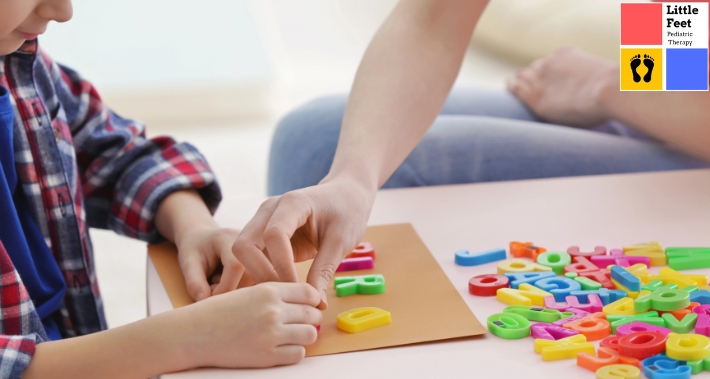
What Should You Do If Your Child Is Dyslexic?
The most important thing any parent of a child with dyslexia can do is support them.
Enrolling them into speech therapy is a great way to do that.
Currently, a medication for dyslexia doesn’t exist.
Instead, we recommend that children with dyslexia develop strategies and accommodations that can help them improve their reading and writing skills and catch up to their peers.
And of course, our speech therapists are always here to help.
Book Your Appointment With Our Pediatric Therapy Clinic Today
Children with dyslexia often feel ashamed and alone.
Dyslexia can be a challenging journey for both children and their families, but with the right support, your child can build the skills and confidence they need to thrive.
Early intervention is key to addressing reading, writing, and communication challenges and preventing long-term academic and emotional struggles.
At Little Feet Therapy, our team of pediatric therapists takes a personalized approach to help children with dyslexia develop strategies that play to their strengths.
Every child learns differently, and we’re here to help find the approach that works best for them.
Book your appointment with Little Feet Therapy today and take the first step toward helping your child succeed.
► Washington, DC Clinic
► Charlotte, NC Clinic
► Raleigh, NC Clinic
► St. Louis, MO Clinic
Founded in 2019, Little Feet Therapy offers on site pediatric physical and occupational therapy treatments for children from 2 months to 18 years old with physical and developmental concerns. Our clinics focus on providing therapy in a child’s natural setting where your child is in familiar surroundings, it puts their mind at ease and helps them focus more on the work they’re doing with their pediatric therapist. Our therapists will work with your child at your home, at school, at daycare, or another place in the community where they feel most comfortable.