
Every child develops speech and language at their own pace.
Some start talking early, while others take a little more time.
But if your child struggles to form words or their speech seems inconsistent, it might be more than just late development.
Childhood apraxia of speech is a motor speech disorder that makes it difficult for children to coordinate the precise movements needed for clear speech.
Even though they know what they want to say, their brain and muscles don’t always work together smoothly to make it happen.
In this article, we’ll take a closer look at what childhood apraxia of speech is, the signs to look out for, possible causes, and how pediatric speech therapy services can help your child strengthen their communication skills and confidence over time.
Continue reading to learn more.
What Is Childhood Apraxia Of Speech?
Childhood apraxia of speech is a motor speech disorder that can make it hard for your child to produce speech.
The brain sends messages to control movements in your mouth, lips, tongue, and jaw in order for you to speak.
In childhood apraxia of speech, there’s an issue in these messages getting through properly.
This can cause your child to be unable to control their movements to create speech and have issues communicating.
However, this doesn’t mean that they don’t know what they want to say.
They’re just unable to say it.
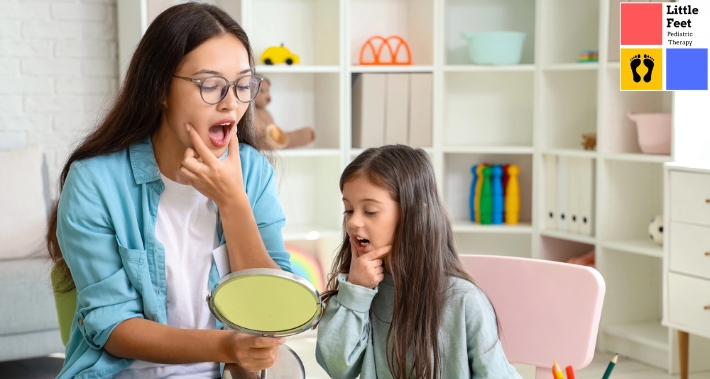
Speech therapy can help your child practice and learn how to coordinate their movements in order to say particular words, syllables, and phrases and communicate more effectively.
How To Tell A Child Has Apraxia Of Speech?
Every child is unique and can display a variety of symptoms based on their age and how severe their apraxia of speech is.
Symptoms typically become apparent at around 18 months, however there are earlier indications as well.
If your child is making fewer vocal sounds than typical before 12 months, or if they speak their first words late, it may be an indication of childhood apraxia of speech.
If your child is older than 3, signs and symptoms of childhood apraxia of speech can include:
- Distorted vowels and constants
- Putting stress on the wrong word or syllable
- Saying the same word differently multiple times
- Irregular pauses between words or syllables
- Difficulty transitioning between sounds
- Equally emphasizing all syllables in a word
- Difficulty imitating simple words
- Difficulty saying longer words but short words are clear
- Voicing errors, like mixing up letters when speaking
Many children with apraxia of speech can also have language deficits.
Due to their difficulty with coordination, it can affect their fine motor skills, delay their language acquisition, and cause differences with development in reading, spelling, and handwriting.
There are many other speech disorders that can have overlapping symptoms.
These can include dysarthria, articulation disorders, or phonological disorders.
If your child is displaying any of the symptoms listed above, it’s a good idea to consult a speech therapist.
They’ll assess the root cause of your child’s speech disorder and create a tailored treatment plan for their unique needs.
What Causes Childhood Apraxia Of Speech?
Most of the time there isn’t a known cause of childhood apraxia of speech.
If your child has apraxia of speech there’s typically no clear problem in their brain.
However, in some cases, damage to the brain or certain brain conditions can cause childhood apraxia of speech, including:
- Traumatic brain injury
- Pediatric stroke
- Infections
Childhood apraxia of speech may also be the result of a syndrome, genetic disorder, or metabolic condition.
Keep in mind that childhood apraxia of speech differs from developmental disorders.
As a result, it isn’t something your child can grow out of.
But speech therapy can help address their challenges so they can communicate more effectively.
What Is The Best Treatment For Childhood Apraxia Of Speech?
The best treatment for childhood apraxia of speech is speech therapy.
Early intervention therapy is key to reducing the risk of long-term problems that your child may face.
At Little Feet Therapy, we’ll do an evaluation to assess the extent of your child’s speech and language abilities.
A pediatric speech therapist will test how well your child says sounds, words, and phrases, and how well other people can understand them.
The goal of speech therapy is to help your child develop their ability to produce speech sounds more clearly.
We’ll put together a tailored treatment plan to address their unique challenges.
This can include helping them learn how to plan movements to produce certain sounds and how to coordinate those muscles.
The goal is to help them learn to control their mouth muscles in the right way to speak clearly.
If your child’s apraxia of speech is more severe, we can help them learn how to communicate using augmentative and alternative communication, or AAC.
This refers to communicating using methods other than speech.
For example, your child can learn how to communicate using sign language, computers, or picture boards.
These tools can help support your child’s communication as they continue to work on their speech through speech therapy.
Keep in mind that speech therapy for childhood apraxia of speech takes time to make significant progress.
Your child will also need your support and encouragement to practice what they learn with their speech therapist.
Find ways to make their speech therapy interactive and fun and work alongside your child’s speech therapist to help them make progress and succeed.
Can A Child With Apraxia Of Speech Learn To Talk?
The goal of speech therapy is to help your child produce more clear speech sounds and increase their communication skills.
With the right treatment, a child with apraxia of speech can learn to talk more effectively.
However, this also depends on several factors, such as:
- When they start speech therapy
- The severity of their childhood apraxia of speech
- Other conditions that they may have
- How seriously they take their speech therapy
Your child may need to use augmentative and alternative communication methods to help support their communication as they continue to develop their verbal speech.
Remember that each child is different and will develop and make progress on their own time.
However, the sooner they start treatment the less risk they have of long-term issues and the better their chances for success.
Speech therapy and family support can help them continue to develop their speech and language skills as they mature.
Book Your Appointment With Our Pediatric Clinic Today
If your child has childhood apraxia of speech, early and specialized support can make all the difference.
At Little Feet Therapy, our pediatric therapy clinic takes a personalized, evidence-based approach to help your child build clear, confident communication skills — at their own pace and in a way that works for them.
Whether your child is just beginning to speak or needs support with alternative forms of communication like AAC, we’ll meet them where they are and help them move forward.
With the right therapy plan and consistent family support, many children with apraxia can learn to express themselves and thrive.
Book your appointment today and take the first step toward unlocking your child’s voice.
► Washington, DC Clinic
► Charlotte, NC Clinic
► Raleigh, NC Clinic
► St. Louis, MO Clinic
Founded in 2019, Little Feet Therapy offers on site pediatric physical and occupational therapy treatments for children from 2 months to 18 years old with physical and developmental concerns. Our clinics focus on providing therapy in a child’s natural setting where your child is in familiar surroundings, it puts their mind at ease and helps them focus more on the work they’re doing with their pediatric therapist. Our therapists will work with your child at your home, at school, at daycare, or another place in the community where they feel most comfortable.