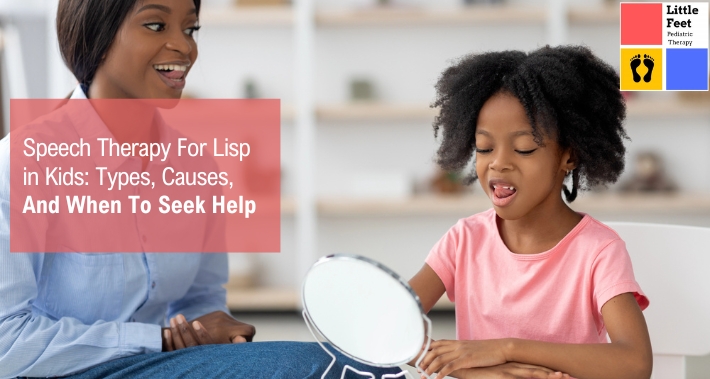
Have you noticed that your child’s “s” or “z” sounds come out more like “th”?
Or that certain words just don’t sound quite right?
For many young children, mild speech differences are part of normal development.
But when a lisp persists beyond the early preschool years, it may be time to take a closer look.
A lisp is a type of speech disorder that affects how certain sounds are produced.
While some children naturally outgrow early speech patterns, others benefit from professional support to correct them.
The longer incorrect sound patterns continue, the harder they can be to change.
In this article, we’ll explore what a lisp is, the different types of lisps, early signs to watch for, and how speech therapy can help your child develop clearer, more confident speech.
What Is A Lisp?
A lisp is a type of speech disorder that affects your child’s ability to speak clearly.
It’s considered to be a functional speech disorder, which means that it is a communication difficulty that occurs without a physical cause.
Instead, it is usually psychological, or in the case of a lisp, tied to difficulty learning.
Lisps usually manifest during childhood, but it is possible to have them as an adult after a traumatic brain injury or other neurological conditions.
There are different types of lisps that each have their own signs.
What Are The 4 Types Of Lisps?
There are four main types of lisps.
But don’t worry, they can all be treated with speech therapy for lisp in kids.
Interdental Lisp
An interdental lisp, also called a frontal lisp, occurs when your child’s tongue protrudes between their front teeth.
You can often see their tongue noticeably protruding between their teeth while they speak, which accompanies their speech sounds.
This directs their air flow forward, which affects the /s/ and /z/ sound, creating more of a /th/ sound.
This is the classic lisp that children under the age of four have, and is often something that they grow out of around this time.
Dentalized Lisp
A dentalized lisp is used to describe the way a child produces certain sounds.
It occurs when their tongue rests on or pushes against their front teeth, producing a muffled sound.
This often changes their /s/ into a /d/ or /t/ sound.
This is another lisp that children can experience under the age of 4, and grow out of as part of their typical development.
Lateral Lisp
A lateral lisp occurs when your child’s tongue is very close to the usual position for /l/ sounds.
They’ll voice that sound with their air flow directed over the sides of their tongue.
This creates a slushy sound that is almost wet as a result.
A lateral lisp is not considered part of normal development, and assessment with a speech therapist is always recommended if your child has this lisp at any age.
Palatal Lisp
The last type of lisp is called a palatal lisp.
This is another one not found in typical speech development, which means you should have your child assessed if you think they might have this lisp.
A palatal lisp is characterised by the mid section of your child’s tongue coming into contact with the soft palate, producing an elongated /ç/ sound followed by a /y/.
What Are The Early Signs Of A Lisp?
The signs of a lisp can start as early as age two in children.
You’ll most often notice either an interdental lisp, or a dentalized lisp.
These most often sound like a /th/ instead of a /s/ or /z/ sound.
While it is possible that your child might grow out of this lisp, this is not always the case.
If the lisp persists past age 4, it’s recommended to have your child assessed by a speech therapist so that their lisp can get corrected.
The longer they keep making incorrect speech sounds, the harder the habit will be for your child to break.
What Causes A Lisp To Develop?
Right now, we don’t exactly know what causes a lisp to develop.
While some people think that allowing your child to continue using a pacifier after a certain age can contribute to this, it’s not an actual factor in children with lisps.
This means that every child who uses a pacifier past the usual age doesn’t necessarily end up with lisp.
Some other possible causes of childhood lisp include:
- Tongue tie
- Jaw alignment challenges
- Incorrect speech learning
The reality is that a lisp is a functional speech disorder.
This means that it can be learned, and unlearned with speech therapy.
While there are certain conditions that can influence a lisp, either physical ones resulting from trauma or neurological ones, in children it is often impossible to pin point the exact cause.
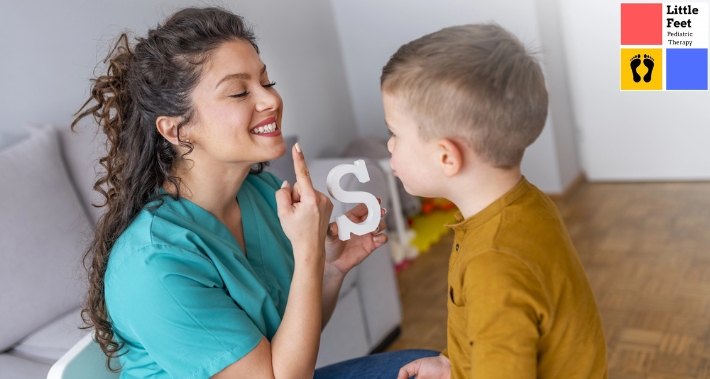
How Speech Therapy Can Help Kids With A Lisp
The good news is that speech therapy is an effective tool to reduce the effect of the lisp on your child’s speech.
Your first step is to find a speech therapist for your child that is child-friendly.
Bonus points if they have lots of experience working primarily with children.
This will make the process smoother, because you’ll be working with an specialized expert who really understands how to motivate children.
Once you book the initial evaluation, your child’s speech therapist will perform a thorough evaluation to understand their strengths and weaknesses.
This will often include a physical component, where your child’s speech therapist will observe your child speaking different words.
This will also include information about your child’s medical history so that they can understand the full picture of their needs.
The evaluation should allow your child’s speech therapist to identify which type of lisp they have, and use that information to create a specialized treatment plan designed to target their areas of communication weakness.
This treatment plan will include take home exercises for you to do with your child outside of therapy sessions, so that they can continue their progress at home and at school.
This treatment plan will often include isolation, which is the process of just focussing on the correct speech sounds.
Then, your speech therapist will help your child build towards applying the correct speech sound into a word.
As your child improves, they will move towards using complete sentences with the correct speech sounds, and then finally carry on conversations with correct speech sounds.
The focus of this therapy will be to teach your child to be aware of their tongue placement while speaking.
If necessary, your child’s speech therapist will also teach them to monitor their jaw placement and use different visual, verbal, and tactile clues to help.
Book Your Appointment With Our Pediatric Clinic Today
A lisp can feel like a small concern at first — especially when speech differences are common in early childhood.
But if incorrect sound patterns continue beyond the expected developmental window, early intervention can make a meaningful difference.
Speech therapy doesn’t just focus on correcting sounds.
It helps your child build awareness, confidence, and the skills they need to communicate clearly at home, at school, and with friends.
The sooner therapy begins, the easier it is to reshape speech habits and support lasting progress.
At Little Feet Therapy, our speech-language pathologists create individualized, child-friendly treatment plans designed to help your child develop strong, accurate speech patterns in a supportive and encouraging environment.
If you’re concerned about your child’s speech, don’t wait and wonder.
Book your appointment today and help your child speak with clarity and confidence.
► Washington, DC Clinic
► Charlotte, NC Clinic
► Raleigh, NC Clinic
► St. Louis, MO Clinic
Founded in 2019, Little Feet Therapy offers on site pediatric physical and occupational therapy treatments for children from 2 months to 18 years old with physical and developmental concerns. Our clinics focus on providing therapy in a child’s natural setting where your child is in familiar surroundings, it puts their mind at ease and helps them focus more on the work they’re doing with their pediatric therapist. Our therapists will work with your child at your home, at school, at daycare, or another place in the community where they feel most comfortable.