You might’ve heard the old saying that once you teach a child to speak, you’ll never get them to stop.
And while that may be true for some kids, others aren’t quite as talkative.
Many children on the autism spectrum, for example, communicate minimally or not through speech at all.
This is known as nonspeaking autism.
But being nonspeaking doesn’t mean a child has nothing to say — far from it.
With the right support, autistic children can express themselves just as meaningfully as anyone else.
Through speech therapy, including the use of augmentative and alternative communication (AAC), these children can learn effective ways to connect with the people around them.
At Little Feet Therapy, we’re passionate about helping autistic children communicate in the way that works best for them — whether through spoken words, gestures, signs, or technology.
In this article, we’ll answer some common questions about nonspeaking autism and explain how speech therapy can empower your child’s unique voice.
What Is Nonspeaking Autism?
First things first: let’s discover the facts behind nonspeaking autism.
Autism in general is a neurodevelopmental difference that can affect your child’s communication, socialization, behavior, and development.
Many autistic children face challenges with their speech and language skills.
Some have mild difficulty understanding the rules of social communication, whereas others face more significant challenges.
For instance, approximately 25% to 30% of autistic children are minimally verbal, meaning they speak fewer than 30 words.
Autistic children who don’t speak at all are considered “nonspeaking”.
If you’ve never heard this term before, you might be more familiar with the misnomer “nonverbal autism”.
At Little Feet Therapy, we prefer to avoid this term because it doesn’t accurately represent the realities of nonspeaking autism.
Nonverbal implies that your child is without words, which isn’t true at all.
Many nonspeaking children can understand words, and even use words in writing or through AAC.
The limitation is in using these words through spoken language.
Thus, “nonspeaking autism” is the preferred term.
Why Do Some Autistic Children Not Speak?
There are many different reasons why your autistic child might not speak.
It’s common for autistic children to experience challenges in developing verbal communication skills.
Some parents of autistic children report typical speech development in the first few years of their child’s life, but may notice a loss of speech as their child’s autism progresses, particularly as other developmental traits become more apparent.
Additionally, there are a few different speech and language disorders autistic children are more likely to have.
Below, we’ll explore a few of these conditions in more detail.
1. Apraxia Of Speech
Apraxia of speech is a type of speech disorder that affects your child’s brain pathways.
It can interfere with your child’s ability to control their speech muscles.
As a result, children with apraxia of speech may have difficulty communicating verbally.
2. Echolalia
Echolalia is common among autistic children.
It causes them to repeat certain words or phrases, either immediately or after a delay.
Thus, autistic children with echolalia often have trouble communicating verbally other than repeating words or phrases they hear people around them use.
3. Stuttering
Stuttering is what’s known as a “fluency disorder”.
That means it’s a disorder with the flow of words.
Children who stutter experience interruptions in their speech flow, known as “disfluencies”.
Autistic children are more likely to have a stuttering disorder.
Early Signs Of Nonspeaking Autism
According to the Centers for Disease Control and Prevention (CDC), most parents of autistic children find out their child’s diagnosis by the age of 2.
If you suspect that your child might be autistic, there are a few signs you can look out for.
Children with nonspeaking autism display the typical early signs of autism.
For instance, you might notice that your baby isn’t responding to their name or babbling by 12 months.
They may also avoid eye contact and prefer to be alone rather than spend time in other people’s company.
Pretend play is a common childhood pastime, especially around 18 months of age, but autistic children typically avoid this activity.
You may also notice that your child is displaying certain self-soothing techniques, such as rocking their body or flapping their hands.
Autism is a spectrum, meaning that the traits associated with it vary widely from person to person.
This is also true for nonspeaking autism.
Some nonspeaking autistic children will be able to use a limited number of words, while others may be unable to speak at all.
In general, if you notice your child isn’t meeting their speech and language developmental milestones, it’s a good idea to seek a speech therapy evaluation.
How Can Speech Therapy Help Nonspeaking Autistic Children?
At Little Feet Therapy, there are plenty of techniques we can use to help your nonspeaking autistic child communicate effectively.
Early intervention is an important component.
If your child seems to be falling behind in their developmental milestones, it’s important to see a speech therapist.
Whether it’s autism or another diagnosis, your child deserves to be able to communicate with their peers.
Communication is essential for your child’s mental health and overall well-being.
A speech therapist can help make sure your child meets this vital social need.
The methods your child’s speech therapist might use depend on a few factors, such as whether or not verbal speech is a possibility for your child.
Let’s take a closer look at how speech therapy can help nonspeaking autistic kids.
1. Determining If They Can Learn To Speak
Before they can put together a treatment plan, your child’s speech therapist will conduct a thorough evaluation to determine whether or not speech is possible for your child.
The goal of a speech therapist is to maximize speech wherever possible.
Thus, we will assess your child to determine their capabilities.
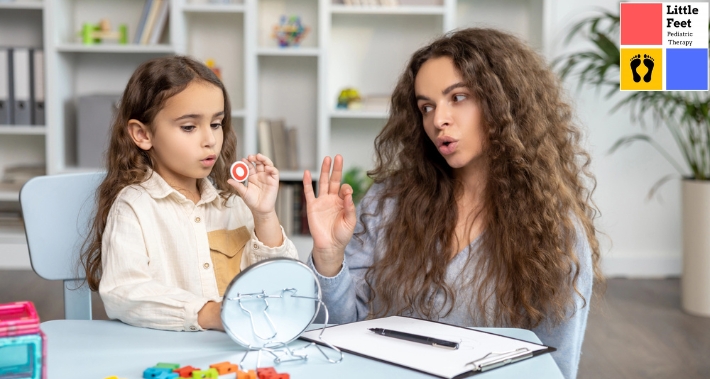
For instance, we might ask your child to imitate certain words or phrases.
We also consider whether your child is capable of speaking when they are trying to get something they want.
If so, we’ll work towards maximizing these speech skills.
If we determine that verbal speech isn’t a possibility for your child, there are other techniques we can use to maximize communication.
2. Exploring AAC Options
AAC is an excellent communication choice for children who can’t speak verbally.
It stands for augmentative and alternative communication, and includes many different tools that can help your child communicate their wants, needs, and feelings.
Generally speaking, we classify AAC tools into one of three categories: no tech, low tech, and high tech.
No tech AAC refers to tools that only require the use of one’s body.
Sign language is one of the most common examples of no tech AAC.
Low-tech AAC options require non-electric equipment.
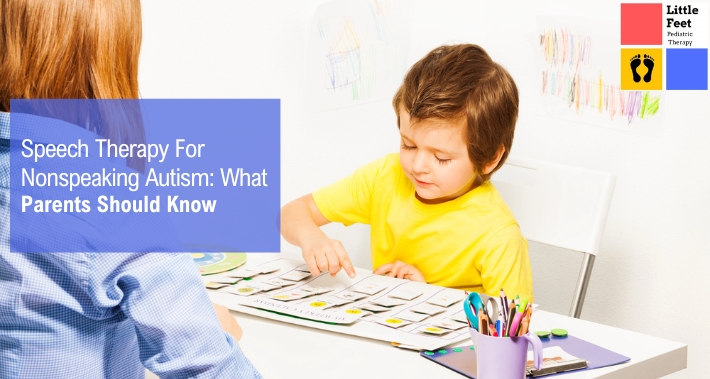
For instance, we can teach your child to use picture boards, alphabet boards, or communication books.
Finally, high tech AAC utilizes electronic equipment to help maximize your child’s communication.
Examples include computers, tablets, and multi button voice output devices.
3. Teaching Other Skills
A speech therapist can also work on improving additional skills that will further improve your child’s communication skills.
For instance, we can help your child practice turn taking during conversations.
This process includes helping your child to learn how to take turns using their AAC equipment as well as tolerate not having their equipment on them when it’s not their turn to speak.
Play is an important component of this type of speech therapy.
For example, we may use play-based activities to help your child practice turn-taking and recognize when it’s their turn to communicate.
Book Your Appointment With Little Feet Therapy Today
Every child deserves a way to express themselves — whether through spoken words, signs, pictures, or technology.
Nonspeaking autistic children have so much to share, and with the right support, they can be heard.
At Little Feet Therapy, our pediatric speech therapists are dedicated to helping every child communicate in the way that suits them best.
Through personalized evaluations, AAC tools, and play-based intervention, we help children connect with the world around them.
Book your appointment with our pediatric clinic today and take the next step in supporting your child’s communication journey.
► Washington, DC Clinic
► Charlotte, NC Clinic
► Raleigh, NC Clinic
► St. Louis, MO Clinic
Founded in 2019, Little Feet Therapy offers on site pediatric physical and occupational therapy treatments for children from 2 months to 18 years old with physical and developmental concerns. Our clinics focus on providing therapy in a child’s natural setting where your child is in familiar surroundings, it puts their mind at ease and helps them focus more on the work they’re doing with their pediatric therapist. Our therapists will work with your child at your home, at school, at daycare, or another place in the community where they feel most comfortable.