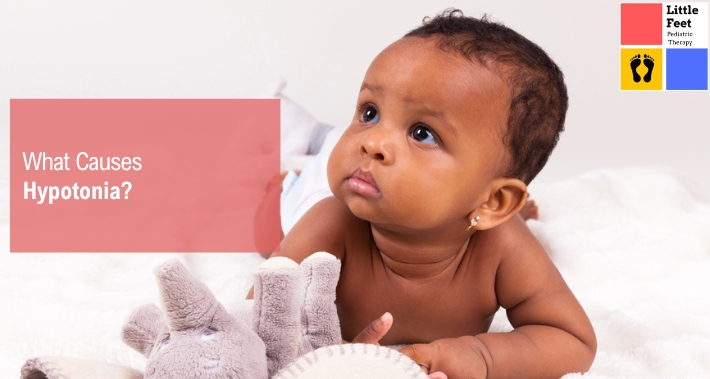
What is hypotonia?
It’s a condition also known as “floppy infant syndrome.”
Its hallmark symptom is decreased muscle tone.
This can create challenges with babies’ development.
Issues with speech, breathing, posture, feeding, and fine and gross motor skills development are quite common in kids with hypotonia.
But what causes hypotonia?
That’s a more complex question we’re here to answer today.
Here at Little Feet Therapy, we offer occupational and physical therapy for children with hypotonia and a number of other childhood conditions that impact development.
In this week’s article, we’ll take a look at some of the possible causes of hypotonia, and what to do about it.
Hypotonia Causes
Usually detected during infancy, this condition can occur on its own.
When it does, it’s called benign congenital hypotonia.
You may also hear it referred to as idiopathic hypotonia.
Idiopathic means it’s a health condition with an unknown cause.
However, it can also occur as part of another condition.
The following conditions often cause hypotonia.
1. Down Syndrome
Down syndrome is one of many different types of genetic disorders.
It’s caused by your baby’s chromosomes not being passed down properly.
Normally, during reproduction, each parent passes down 23 chromosomes, and the child receives 46 chromosomes in total.
But in some cases, there’s an error in their 21st chromosome, which causes Down syndrome.
There are three different types of Down syndrome.
Trisomy 21 is when there’s an extra copy of the 21st chromosome in every cell in the body.
Mosaicism is when there’s an extra copy of the 21st chromosome in only some of the cells in the body.
Translocation is when there’s an extra part of the 21st chromosome, rather than a full extra copy.
According to the United Nations, around 0.1% of the population worldwide has Down syndrome.
That’s more than 6 million people.
Some of the common physical traits of Down syndrome include:
- Gross motor skills developmental delays
- Fine motor skills developmental delays
- A shorter neck
- A smaller head
- Slanted eyes
- A larger tongue
- Differently shaped ears
- A flatter face
- Wider and shorter hands
- Shorter fingers
- White spots on their irises
From an intellectual perspective, Down syndrome kids typically show:
- Reduced attention spans
- Poor judgment
- Impulsive behavior
- Speech and language developmental delays
- Delayed learning
From a hypotonia perspective, poor muscle tone is also a common physical trait for kids with Down syndrome.
In fact, a 2013 study by Dey Et. Al. mentions that almost all children with Down syndrome will have hypotonia in one form or another.
In particular, the muscles that support their neck are often weak and loose.
This is due to hypotonia which can also cause spinal compression.
Treatment from a Down syndrome pediatric therapist is very important for these kids.
Without treatment, kids with Down syndrome frequently end up with orthopedic problems later in life.
2. Cerebral Palsy
Cerebral palsy involves a group of disorders that impact your muscle movement, coordination, and posture.
In most cases of cerebral palsy, there is no known cause.
When the cause is known, however, this most commonly occurs due to brain injury to the areas of the brain that control your child’s muscles.
It can also occur due to gene mutations, lack of oxygen to the brain during labor, infections, or jaundice.
If your child has cerebral palsy, they’re likely to experience developmental delays in:
- Learning to crawl
- Learning to walk
- Learning to speak
- Learning to write
- Muscle coordination
It can also result in some of the following symptoms:
- Exaggerated reflexes
- Seizures
- Difficulty swallowing
- Involuntarily movements
- Intellectual disabilities
There are a number of different types of cerebral palsy.
The most common type is spastic cerebral palsy, but there is also hypotonic cerebral palsy.
Hypotonia is a common symptom of this.
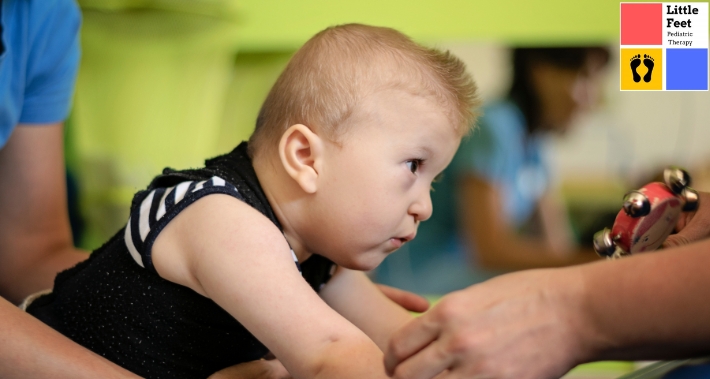
Kids with hypotonic cerebral palsy often have trouble holding their head up.
This can cause difficulty with tummy time, which is important for your child’s development.
Cerebral palsy pediatric therapy is particularly important in this case.
3. Muscular Dystrophy
Muscular dystrophy is a genetic disease.
It’s caused by a genetic mutation that occurs in your child’s DNA.
This impacts the gene that controls muscle health and the protein used to repair them.
Muscular dystrophy is also genetic, which means that if a parent has muscular dystrophy, they can pass it on to their kid(s).
Muscle weakness is one of the hallmark traits of muscular dystrophy.
Other common symptoms include:
- Waddling gait
- Difficulty with balance and coordination
- Difficulty walking on their toes
- Difficulty running
- Delays with language acquisition
- Chronic fatigue
- Sleep issues
- Respiratory issues
There are a number of different types of muscular dystrophy, and most of them have hypotonia as a symptom.
If your child has muscular dystrophy, pediatric therapy can help.
4. Autism
Autism is a neurodevelopmental difference.
That means it’s a difference in how the brain develops.
Autistic people see and navigate the world differently than others.
In general, autistic traits involve communication differences, inconsistent social interactions, and repetitive behaviors.
An autistic child may:
- Have difficulty making and maintaining friends
- Have difficulty maintaining eye contact
- Misunderstand the meaning of facial expressions and other nonverbal cues
- Overshare their interests
- Repeat certain words, behaviors, or actions
- Be resistant to change
- Have difficulty switching tasks
- Have difficulty following directions
From a physical development perspective, autistic children will often also:
- Have difficulty with balance and coordination
- Have poor posture
- Experience motor skills developmental delays
A 2007 study by Ming, Brimacombe, and Wagner examined a group of 154 kids diagnosed with autism.
They found that more than half of them also had hypotonia.
The exact relationship between autism and hypotonia is not yet fully understood.
So, it’s difficult to say if autism causes hypotonia directly.
But these two conditions are clearly related.
Autism pediatric therapy can help your child develop these skills.
5. Other Causes
Hypotonia can also be caused by a variety of other nervous system, muscle, and genetic disorders, including:
- Prader-Willi syndrome
- Myotonic dystrophy
- Marfan syndrome
- Tay-Sachs disease
What To Do If Your Child Has Hypotonia
If your child has hypotonia, early intervention is important.
The first step is to see a pediatric physical therapist.
They’ll examine your child’s motor and sensory abilities, balance, coordination, cognition, reflexes, nervous system function, and more.
The tests may also examine what is causing your child’s poor muscle tone.
From there, the pediatric therapist can decide on what treatments may be best for your child.
Treatment may work to increase your child’s muscle strength, muscle tone, and sensory stimulation.
Book Your Appointment With Little Feet Pediatric Therapy Today
Does your child have hypotonia?
Or do you suspect they may?
If so, our pediatric therapy team can help.
Book your appointment with Little Feet Therapy today to find out how.
► Washington, DC Clinic
► Charlotte, NC Clinic
► Raleigh, NC Clinic
► St. Louis, MO Clinic
Founded in 2019, Little Feet Therapy offers on site pediatric physical and occupational therapy treatments for children from 2 months to 18 years old with physical and developmental concerns. Our clinics focus on providing therapy in a child’s natural setting where your child is in familiar surroundings, it puts their mind at ease and helps them focus more on the work they’re doing with their pediatric therapist. Our therapists will work with your child at your home, at school, at daycare, or another place in the community where they feel most comfortable.