Here at Little Feet Therapy, we offer pediatric therapy for a wide range of different developmental diagnoses.
In some cases, these diagnoses stand on their own.
For example, we usually don’t know what the cause is of developmental delays in a child’s motor skills.
However, many other diagnoses are connected – and sometimes in ways you might not expect.
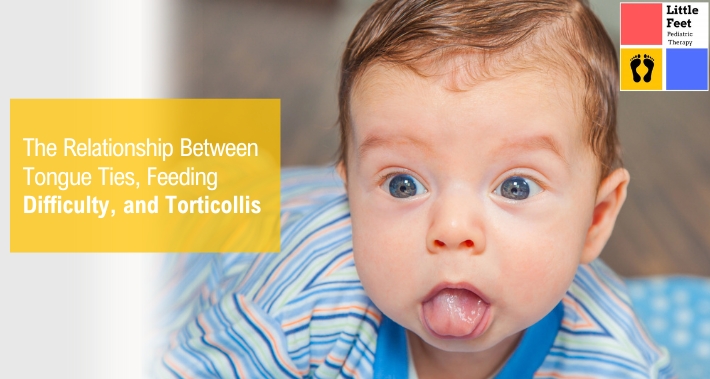
In this article, we’ll be taking a look at the connection between three different diagnoses: tongue and lip ties (TOTs), torticollis, and feeding challenges.
RELATED: Infant Feeding Services For Tethered Oral Tissues (TOTs)
We’ll start with a quick outline of each of these diagnoses.
From there, we’ll explore the relationship between the three.
What Is Torticollis?
We’ve written extensively about torticollis on this blog.
We’ve previously outlined some frequently asked questions about torticollis, and how to prevent torticollis for newborns.
However, our physical therapy for torticollis page will answer this question and more about the condition, in greater detail than we’ll do here.
But here’s a quick outline.
Torticollis is a condition where your infant’s head and neck seem to be “stuck” in an unusual position, usually tilted to one side.
Signs your child may have torticollis include:
- A tilted or turned head to one side
- Seeming to struggle turning their head in different directions
- Difficulty following objects with their eyes
- Difficulty with feeding (breast or bottle)
- Plagiocephaly, or a flat spot on their head as a result of always lying on it
- Difficulty lifting their head during tummy time
Torticollis can be painful, but isn’t usually.
Known causes include a shortened SCM muscle, unusual womb positioning, and an injury during birth.
However, it’s often not known what causes it.
Torticollis may seem alarming, but it’s relatively easy to treat in most cases.
The pediatric occupational therapists and pediatric physical therapists here at Little Feet Therapy can help.
What Is TOTs?
Tongue ties and lip ties are together referred to as “TOTs” – tethered oral tissues.
They’re both related to frenula – a thin band that connects two different body parts.
With a tongue tie, it’s related to the lingual frenulum.
That’s the band that connects your child’s tongue with the bottom of their mouth.
A lip tie, on the other hand, is related to the frenulum connecting your child’s upper lip with their gums.
In either case, the affected frenulum is too thick, too short, or too tight.
This can restrict tongue or lip movement, which may cause difficulty feeding.
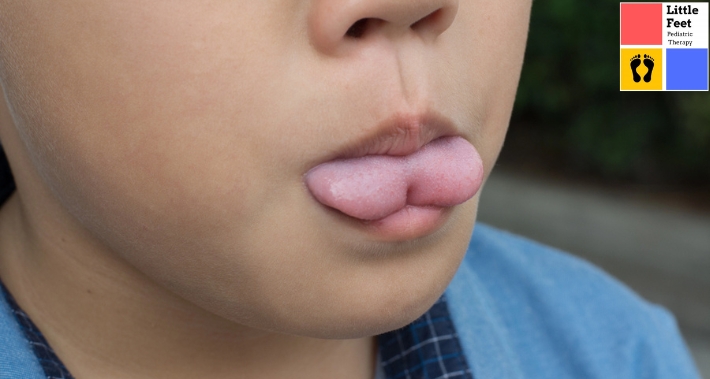
If your child has a tongue tie, you may notice their tongue is heart shaped when they stick it out.
As well, you may notice they can’t stick their tongue out past their bottom lip.
It may also be that they can’t raise their tongue to the roof of their mouth.
They may also have a smaller than normal upper lip.
If it’s interfering with feeding, you may notice the following:
- Difficulty latching
- A clicking sound while they feed
- Frequent gassiness
- Blisters on their lips
- Difficulty keeping milk in their mouth while feeding
- Longer than normal feeding sessions
- Resistance to feeding
- A tilted and tense head and neck
- Falling asleep while feeding
- And others
If you’re breastfeeding, you may notice:
- Pain while breastfeeding
- Cracked, bleeding, or otherwise damaged nipples
- Frequently clogged milk ducts
- Not feeling empty after feeding
- And others
We’re not sure what causes TOTs, but it’s thought that there’s a genetic component.
Do TOTs Cause Feeding Issues?
Often they do, yes.
However, there are other conditions that can lead to poor feeding as well.
Premature babies often have feeding difficulties, for example.
However, this usually improves as they grow older.
Other potential causes of poor feeding can include:
- Down syndrome
- Cerebral palsy
- Jaundice
- Congenital heart conditions
- Autism
It’s important to note that poor feeding isn’t the same thing as picky eating.
RELATED ARTICLE: How To Deal With A Child Who’s A Picky Eater
What’s The Link Between Torticollis And Tongue Tie?
On the surface, it may not seem like there’s a link between these two conditions.
They are, of course, separate from each other.
Scientific research on this is limited at this point, and more needs to be done.
But there are a few different reasons why this seems, anecdotally, to be the case.
Remember earlier, when we talked about how the SCM muscle is commonly shorter in infants with torticollis?
That same muscle tightness is common in kids with tongue ties as well.
As well, particularly restrictive tongue ties can interfere with a child’s ability to breathe.
This may cause them to stretch in one direction to clear their airways.
At our pediatric clinics, we’ve noticed a link between the two.
Now, we’ve already looked at the connection between tongue tie and poor feeding.
How does torticollis come into play there?
Naturally, your baby needs full range of motion of their neck in order to latch properly while feeding.
To latch properly, a baby needs to not only be able to turn their head to either side, but also extend their neck.
Why Is This Connection Important?
While a causal link has yet to be established between tongue tie and torticollis, it’s still an important consideration.
If a child’s torticollis is linked with their tongue tie, we need to take a different approach to treatment.
Typically, torticollis treatment is geared toward relieving muscle tension in your child’s neck and trunk muscles.
However, if it’s caused by a tethered oral tissue, they may need to have that relieved in order for torticollis treatment to be effective.
That’s why here at Little Feet Therapy, our pediatric therapists are trained to look for and recognize the signs of a tongue tie while evaluating for torticollis.
We are also trained in how to treat tongue tie and TOTs.
This helps us make sure your child receives the best possible treatment for their conditions.
Book Your Appointment With Little Feet Therapy Today
Have you noticed your child has preference for turning their head to one side?
Or do they seem to have trouble feeding?
Does their tongue not clear their bottom lip when they try to stick it out?
If so, we’re here to help.
Early intervention therapy is particularly important for these conditions.
Torticollis becomes more difficult to treat as your child gets older, as do feeding difficulties.
As well, it’s important that they receive adequate nutrition from a young age.
So, if you notice any of the above signs, don’t wait and seek professional help as soon as possible.
Book your appointment with Little Feet Therapy today.
► Washington, DC Clinic
► Charlotte, NC Clinic
► Raleigh, NC Clinic
► St. Louis, MO Clinic
Founded in 2019, Little Feet Therapy offers on site pediatric physical and occupational therapy treatments for children from 2 months to 18 years old with physical and developmental concerns. Our clinics focus on providing therapy in a child’s natural setting where your child is in familiar surroundings, it puts their mind at ease and helps them focus more on the work they’re doing with their pediatric therapist. Our therapists will work with your child at your home, at school, at daycare, or another place in the community where they feel most comfortable.