If your child has spina bifida, you likely have many different questions racing through your head.
You might be worried about how this condition will affect their physical abilities and development.
But finding the right pediatric therapist can help.
Little Feet Therapy is a pediatric therapy clinic helping children overcome their challenges and to reach their full potential.
Our pediatric therapy team is experienced with spina bifida and can help address the challenges your child may face because of this condition.
In this article, we’ll take a look at the potential risk factors that can contribute to the development of spina bifida, and how pediatric physical therapy and occupational therapy can help.
RECAP: What Is Spina Bifida?
We’ve talked about spina bifida before, in our previous article on pediatric therapy for spina bifida.
But here’s a quick recap.
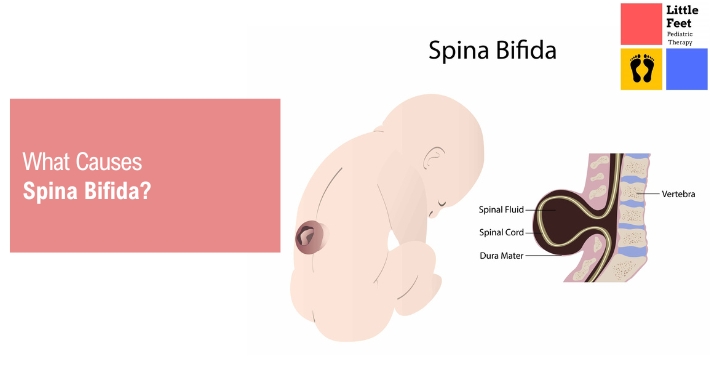
Spina bifida is a condition in which the spine and spinal cord don’t develop properly in the uterus.
It’s a type of neural tube defect.
The neural tube is the structure in a developing embryo that eventually transforms into the central nervous system, which includes the baby’s spinal cord and brain.
Spina bifida occurs when a portion of the neural tube doesn’t fully close.
There are three common types of spina bifida.
Spina bifida occulta is the most common type and occurs when there’s an opening in one or more vertebrae.
Myelomeningocele is much more serious and occurs when there’s an opening in several vertebrae.
Part of the spinal cord and its protective covering and nerves can push through this opening.
This forms a sac on the baby’s back, typically causing nerves and tissues to be exposed, which can lead to health complications.
Lastly there’s meningocele, which occurs when a sac of spinal fluid bulges out of an opening in the spine.
While nerves aren’t affected in meningocele, it can still lead to minor health complications.
We Don’t Currently Know What Causes Spina Bifida
Currently, we don’t actually know what causes spina bifida.
However, there are a number of possible risk factors that can increase the likelihood of developing this condition.
Let’s take a closer look at some of these risk factors that may affect the development of spina bifida.
1. Vitamin B9 Deficiency During Pregnancy
Vitamin B9, also known as folate, is part of the B complex of vitamins.
B vitamins are a collection of water soluble vitamins that are essential for many of our body’s metabolic processes.
Deficiencies in vitamin B9 can increase the risk of neural tube defects in the fetus during pregnancy, such as spina bifida.
For those who are pregnant, it’s often recommended that you get all of your B vitamins, especially folate.
Consult with your doctor if you are pregnant and concerned about your folate intake.
You can also get manufactured folic acid, which your body converts into folate.
Folic acid can help support your baby’s development in utero, including their brain, spine, and skull, and prevent birth defects.
2. Family History Of Neural Tube Defects
It’s possible that having one child with a condition that affects their neural tube may increase the risk of having another child that has the same condition.
The risk gets greater if you have multiple children with this condition.
Additionally, having a neural tube defect as a parent can also increase the risk of giving birth to a baby with spina bifida.
A 2017 study by Dupépé Et. Al. looked at 254 patients with spina bifida and their mothers.
They found that 16.9% of them had a family history of neural tube defects.
As well, 8.7% of them had a family history of other nervous system disorders, including Down syndrome and cerebral palsy.
More research is needed to better understand this.
However, keep in mind that the majority of babies that have spina bifida are born to parents who don’t have any family history of it.
As well, parents with spina bifida can give birth to kids who don’t have it.
3. Uncontrolled Diabetes During Pregnancy
Diabetes is a chronic condition that occurs when your blood sugar, or glucose, levels are too high.
It develops in response to your pancreas not being able to produce enough insulin, which can be the result of insulin resistance, autoimmune disease, hormonal imbalance, and more.
There are several different types of diabetes and it’s a commonly occurring condition in people of all ages.
Some general common symptoms of diabetes can include:
- Fatigue
- Numbness in the extremities
- Slow healing cuts or sores
- Regularly occurring skin or vaginal yeast infections
- Dry mouth
- Increased thirst
- Frequent urination
- Unexplained weight loss
- Blurred vision
If left untreated, uncontrolled diabetes can lead to serious long term health complications, particularly with your blood vessels and nerves, which support all of your body’s tissues.
In 2021, Georgescu Et. Al. looked at a case of a 24 year old woman with an unplanned pregnancy and poorly managed type I diabetes.
An ultrasound revealed neural tube defects, which is the hallmark of spina bifida.
Another study, this one in 2019 by Mowla Et. Al, looked at 181 cases with spina bifida in Finland, and found 2.2% of them had diabetic mothers.
That might not sound like a lot, but consider that spina bifida affects only one in every 2,875 births in the US each year.
More research is needed to better understand this association.
4. Other Possible Factors
There are several other possible risk factors that can be associated with the development of spina bifida in utero.
These can include:
- Medications that interfere with folate absorption
- Obesity
- Environmental factors
- High body temperature in the early stages of pregnancy
If you’re aware of any of these potential risk factors, consider speaking to a healthcare professional and taking the right precautions.

What To Do If Your Child Has Spina Bifida
If your child has been diagnosed with spina bifida, pediatric therapy can help.
A pediatric physical therapist can help your child increase their mobility so that they can be more independent.
Treatment plans will be tailored to your child based on their age, developmental milestones, and unique challenges.
Pediatric physical therapy for spina bifida can include an at home exercise program to help improve your child’s mobility and ability to participate in activities.
It can also help fit your child with assistive devices tailored to their specific needs to help them move around more freely.
RELATED: Wheelchair and Orthotics Fittings for Children
Additionally, a pediatric occupational therapist can help your child with spina bifida learn and develop their fine motor skills.
This helps them develop stronger handwriting and self care skills, among others.
Ultimately, the goal of pediatric therapy is to help your child better participate in everyday activities and develop their self sufficiency.
Book Your Appointment With Our Pediatric Therapy Clinic Today
If your child has been diagnosed with spina bifida, please remember you’re not alone.
At Little Feet Therapy, we offer both pediatric physical therapy and pediatric occupational therapy for spina bifida.
Book your appointment with Little Feet Therapy today.
► Washington, DC Clinic
► Charlotte, NC Clinic
► Raleigh, NC Clinic
► St. Louis, MO Clinic
Founded in 2019, Little Feet Therapy offers on site pediatric physical and occupational therapy treatments for children from 2 months to 18 years old with physical and developmental concerns. Our clinics focus on providing therapy in a child’s natural setting where your child is in familiar surroundings, it puts their mind at ease and helps them focus more on the work they’re doing with their pediatric therapist. Our therapists will work with your child at your home, at school, at daycare, or another place in the community where they feel most comfortable.