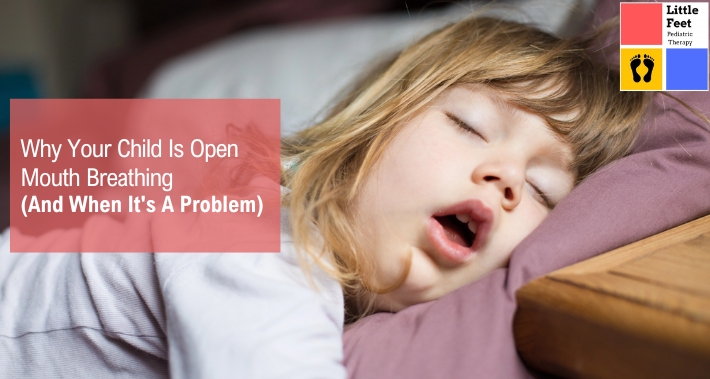
Have you ever noticed your child sleeping with their mouth open?
Maybe it happens sometimes when they’re playing or watching TV too.
It’s a common observation for many parents, and you might wonder if it’s something to be concerned about.
“Open mouth breathing” simply means breathing through your mouth instead of your nose.
Now, everyone does this from time to time.
If your child has a cold, or they’ve been exerting themselves, this is normal.
However, breathing through the mouth regularly can actually lead to some bigger issues over time.
It can also be indicative of some other issues.
At Little Feet Therapy, we understand how important proper breathing is for your child’s overall development.
In fact, babies and young children especially rely on nasal breathing.
Our pediatric therapists are specially trained to help children of all ages who are experiencing mouth breathing.
For our littlest ones, we can address issues, such as tongue-ties, and lip ties, that can contribute to this pattern.
And for older kids, we work on retraining breath patterns to encourage healthy nasal breathing.
We believe in a holistic approach, looking at how everything in the body works together.
In this article, we dive into understanding open-mouth breathing in children.
We’ll look at what it is, what causes it, and how pediatric physical therapy can help your child breathe easier and healthier.
What Is Open Mouth Breathing?
Let’s get clear on what we mean by open mouth breathing.
It’s when air primarily enters and exits through the mouth instead of the nose.
You might see this happening while your child is sleeping, but it can also occur during the day.
It’s important to know that while everyone breathes through their mouth occasionally.
This is especially true when they’re doing something active or if their nose is stuffed up.
However, the concern arises when it becomes a consistent habit.
Think of it this way: your nose is designed to be the primary pathway for breathing.
When you breathe through your nose, tiny hairs filter out dust and germs.
The air also gets warmed and moistened, which is good for your lungs.
Your nose even makes something called nitric oxide, which helps with blood flow and your immune system.
For babies, nasal breathing is especially important in their first few months of life.
In fact, babies are sometimes referred to as “obligate” or “preferred” nose breathers.
This means they naturally rely on breathing through their noses.
That’s especially true when they’re feeding from a breast or bottle.
They need to be able to breathe through their nose to eat properly with their mouth.
So, if your baby is consistently breathing through their mouth, it’s worth looking into.
Why Is Your Child Breathing With Their Mouth Open?
You might be wondering why your child is breathing with their mouth open in the first place.
There can be several reasons, and often it’s due to something blocking their nasal passages.
Here are some common causes of nasal obstruction:
1. Nasal Congestion
This is the most common reason.
If your child has a cold, the flu, or allergies, their nose can get stuffed up with mucus.
This makes it harder to breathe through their nose, so they naturally switch to breathing through their mouth.
In babies, even just a little bit of mucus can make nasal breathing difficult.
This usually clears itself up after their illness has run its course.
2. Enlarged Adenoids Or Tonsils
These are tissues in the back of the throat that can sometimes get bigger, especially in young children.
When they’re enlarged, they can block the airflow through the nose and throat, leading to mouth breathing.
Mouth breathing itself can contribute to your child’s tonsils and adenoids staying enlarged as well.
This is more common in children between 2 and 4 years old, but it can happen in younger babies too.
3. Deviated Septum
Your septum is a wall of cartilage and bone that separates your nostrils.
If your child’s septum is deviated, that means it’s crooked or out of alignment.
A significantly deviated septum can make it harder for air to pass through one or both sides of the nose.
4. Other Nasal Passage Blockages
Sometimes, there can be enlarged blood vessels, bones, or other tissues in the nasal passage that cause a blockage.
It’s also possible for young children to stick things in their nose that cause blockages.
In rare cases, there might be a condition called choanal atresia, where the nasal airway is partly or fully blocked by tissue.
5. Tongue-tie
For our younger patients, especially babies, tongue-tie can impact nasal breathing.
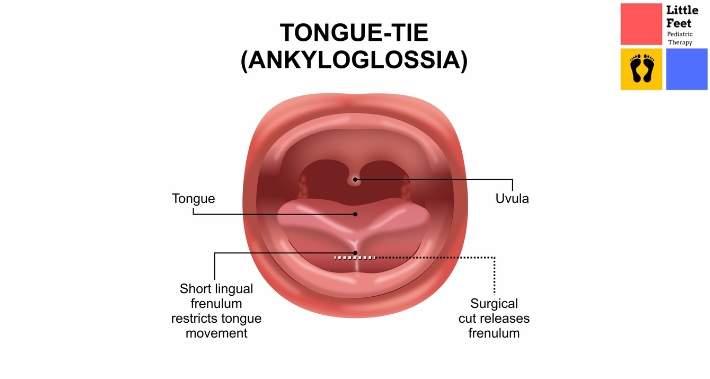
A tongue-tie occurs when the small piece of skin under the tongue (the frenulum) is too tight or short.
This limits the tongue’s movement.
This can make it difficult for your child’s tongue to rest in the roof of their mouth, which is the proper position for nasal breathing.
It can also affect breastfeeding and later on, eating, swallowing, and speech.
At our clinic, we are skilled in assessing and treating tongue-ties in infants to help improve their tongue mobility and promote nasal breathing.
RELATED: The Relationship Between Tongue Ties, Feeding Difficulty, and Torticollis
6. Other Possible Causes
Sometimes, even if there isn’t a physical blockage, the way your child’s mouth and jaw are structured can make it hard to close their mouth properly.
The shape of their jaw might just naturally keep their mouth slightly open.
In these cases, they might end up breathing through their mouth because it’s difficult to keep it closed.
It’s also important to consider habits. Things like sucking on a thumb or pacifier for a long time can affect how the jaw develops.
It can put pressure on the roof of your child’s mouth, making their jaw narrower, leading to more mouth breathing.
If your baby stops breastfeeding or bottle-feeding before they are three months old, they may be at an increased risk for mouth breathing.
Breastfeeding helps promote nasal breathing and strengthens the muscles in the mouth and tongue, which helps the jaw develop properly.
In the cases of a cold or allergies, sometimes even after the initial cause of mouth breathing goes away, the habit of breathing through the mouth can stick around.
This is why it’s important to address mouth breathing, even if it seems to have started with a temporary issue.
Is Mouth Breathing Bad For Children?
When mouth breathing becomes chronic, it can lead to a number of problems for your child’s health and development.
For example, mouth breathing will cause your child’s mouth to dry out.
Not only is that uncomfortable, saliva helps wash away bacteria and food particles, which helps protect against tooth decay.
As a result, kids with open mouth breathing are more prone to cavities, gingivitis, misaligned teeth, and other dental issues.
Other issues common with kids with open mouth breathing include:
- TMJ disorders (jaw pain)
- Chronic bad breath
- Chronic headaches
- Sleep apnea and other sleep disruptions
- Chronic fatigue, due to poor sleep quality
- Difficulty concentrating
- High blood pressure
- Irritability and fussiness
- Fine motor skills developmental delays
- Gross motor skills developmental delays
- Social skills developmental delays
- Poor performance in school
- A lisp (speech therapy can help)
Since open mouth breathing can affect focus and concentration, your child may be misdiagnosed with an attention or behavior disorder, like ADHD.
Chronic open mouth breathing can even affect facial development over time.
In particular, you might notice your child has:
- A longer face
- A narrower jaw
- A high-arched palate (the roof of their mouth)
- Poor posture
This can cause things like overbites, or a jaw that’s more V-shaped.
This happens because your child’s tongue isn’t resting in the roof of their mouth as it should.
This normally helps support the upper jaw’s growth.
This is why it’s often easier to address these issues if mouth breathing is corrected before age 7, while their jaws are still developing.
In terms of posture, your child may try to compensate for their difficulty breathing by holding their head forward.
This can create other postural imbalances throughout the body.
How Can Physical Therapy Help With Mouth Breathing?
At Little Feet Therapy, we can help your child overcome mouth breathing.
We understand that it’s often more than just a habit – it can be linked to underlying physical factors that we are trained to address.
Your pediatric physical therapist will start with an evaluation of your child’s condition.
RELATED: What Happens During A Pediatric Physical Therapy Evaluation?
They’ll look to find out the underlying cause of your child’s mouth breathing.
If you have any diagnoses from your doctor, that will help.
From there, they can either put together a treatment plan designed to help, or refer you to another provider depending on the cause.
This may include a referral to a pediatric dentist, orthodontist, or ENT (ear, nose, and throat) specialist to provide comprehensive care for your child’s mouth breathing.
Let’s look at some specifics at how physical therapy for open mouth breathing can help.
1. Breathing Retraining
One of the key ways we help is through breathing retraining.
Our physical therapists can guide your child in learning how to breathe correctly through their nose.
We work on techniques to improve airflow and help your child become more aware of their breathing patterns so they can consciously shift from mouth to nasal breathing.
A crucial aspect of our treatment is addressing the correct resting tongue position.
As we discussed, the tongue should ideally rest in the roof of your child’s mouth.
This position is essential for proper nasal breathing and healthy jaw development.
When their tongue rests in the roof of the mouth, it exerts a gentle outward and forward force on the upper jaw.
This supports its growth and counteracts the inward pressure from their cheeks and lips.
This approach can be effective for older children with chronic mouth breathing.
2. Posture Improvements
Chronic open mouth breathing can cause poor posture, as we mentioned earlier.
Good posture is important for kids as they grow.
It helps make sure their joints, bones, muscles, and ligaments develop in proper alignment.
It can also help them feel more confident, more energetic, and reduce chronic pain.
And of course, it’s difficult to take full, proper breaths with poor posture.
Your pediatric physical therapist can assess and address their posture issues.

3. Pediatric Physical Therapy For Open Mouth Breathing With Tongue-Tie
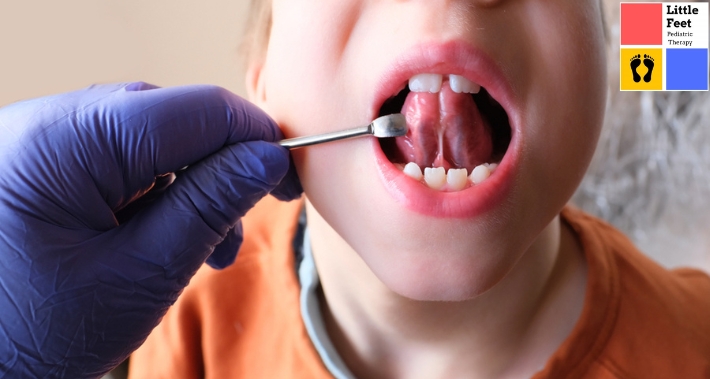
For infants with a tongue-tie, we provide specialized therapy to improve tongue mobility.
While sometimes a surgical release (frenotomy) might be necessary, physical therapy can help optimize the tongue’s function before and after such a procedure.
Our exercises focus on releasing tension in the tongue and surrounding muscles.
This can help your baby achieve a better latch for feeding.
It also promotes a proper resting tongue posture for nasal breathing.
There is a known connection between tongue tie and torticollis as well.
So if your child has torticollis pediatric physical therapy can help with that as well.
Book Your Appointment With Our Pediatric Therapy Clinic Today
Is your child frequently breathing through their mouth?
If so, it could be a sign of an underlying issue for which our experienced team of pediatric therapists can help.
Remember, addressing mouth breathing early can make a significant positive impact on your child’s long term health and development.
At Little Feet Therapy, our pediatric therapists take a holistic, individualized approach to support better breathing and overall wellness.
We’ll help uncover the root cause and guide your child toward healthier habits.
Book your appointment with Little Feet Therapy today to get started on your child’s path to easier breathing and thriving development.
► Washington, DC Clinic
► Charlotte, NC Clinic
► Raleigh, NC Clinic
► St. Louis, MO Clinic
Founded in 2019, Little Feet Therapy offers on site pediatric physical and occupational therapy treatments for children from 2 months to 18 years old with physical and developmental concerns. Our clinics focus on providing therapy in a child’s natural setting where your child is in familiar surroundings, it puts their mind at ease and helps them focus more on the work they’re doing with their pediatric therapist. Our therapists will work with your child at your home, at school, at daycare, or another place in the community where they feel most comfortable.